Mr. Hat writes in that this month’s Game Informer may let the cat out of the bag about what’s so revolutionary about the Revolution.
Hasn’t this been done before?
Mr. Hat writes…
For months and months we’ve all been wondering what the new and “revolutionary” aspects of the Nintendo Revolution would be. It looks like we finally have an answer… I just got the newest issue of Game Informer today, and there’s a pretty lengthy article in there about everything the magazine knows so far about the next generation consoles. Hidden pretty well in there is the Nintendo update-
“However, Nintendo may have to pull a rabbit out of it’s hat to become a major player in the next generation. That rabbit, GI has learned, *is a touch screen*. A source at a major development studio recently revealed to us details regarding Nintedo’s devlopment kit for the Revolution…
The most shocking is that the Revolution *Uses a touch screen as it’s controller. There is no analog stick or shoulder buttons. The touch screen on the face of the controller is designed to be fully customizable. So, the developer can configure the buttons any way they se4e fit, instead opting for virtual levers or other stylus-related inputs.*”
This makes perfect sense- even though the touch screen is currently being utilized with the DS, it’s still a technology that hasn’t been widely used before. This also speaks to Iwata’s statement that developers may be wary of the new technology- after all, we’ve spent a decade expecting to control our characters with some kind of D-Pad or Analog stick. This would change everything, and could potentially scare people away. I’m betting that this is for real.
Article at Joystiq


March 17, 2005
Apple Developing a Two Button Mouse?
Appleinsider claims that Apple is "feverishly working" on a two-button wireless optical mouse to be released soon.
According to the rumor site, the reason for the departure from the single-mouse stance stems from Apple's recent foray into attracting the low-end PC market with the Mac Mini.
One teaser quote included claims "Jaws will drop". No timeframe for introduction is provided. Two buttoned mice have been long rumored from Apple.
The earliest in our archives date back to 2002. Meanwhile, a October 2000 Wired article speculating the introduction of a two-button Apple mouse for the (then) beta Mac OS X.Mac Rumors: Apple Mac Rumors and News You Care About
March 15, 2005
Comcast and TiVo Strike a Deal
 It's official. After reported rumors in both the Wall Street Journal and USA Today, TiVo and Comcast have announced a deal this morning. Comcast Corp. expects to begin selling the new DVRs, which will carry the TiVo brand, by mid to late 2006. Financial details were not disclosed but it was reported that Comcast will let TiVo extend to Comcast subscribers the advertising it sells in the form of interactive video clips that automatically appear in the TiVo menu.
March 7, 2005
MSNBC - Moon probe could kill conspiracy theory
A European spacecraft now orbiting the moon could turn out to be a time machine of sorts as it photographs old landing sites of Soviet robotic probes and the areas where American Apollo crews set down and explored.
New imagery of old Apollo touchdown spots, from the European Space Agency’s SMART-1 probe, might put to rest conspiratorial thoughts that U.S. astronauts didn’t go the distance and scuff up the lunar landscape. NASA carried out six piloted landings on the moon between 1969 and 1972.
Fringe theorists have said images of the waving flag — on a moon with no atmosphere — and other oddities show that NASA never really went to the moon. No serious scientist or spaceflight historian doubts the success of the Apollo program, however.
MSNBC - Moon probe could kill conspiracy theory
Track Your Family with Microsoft
Microsoft researchers have put a new twist on telling time, creating a digital wall clock with hands for each member of the family.
Instead of numbers, the hands point to places — work, school, home — and can track a person's location to show where he or she is at any time. Not good for teenagers, perhaps, but something parents might find interesting.
Don't expect to buy the clock in stores anytime soon. That invention, and hundreds of others, were on display yesterday at Microsoft's annual science fair of the most futuristic ideas from the company's research division.
The people-tracking clock is an idea out of Microsoft's research laboratories in Cambridge, England. Technology in cellphones these days can easily track a person's location, and that information could be sent to the clock to be seen by those at home.
"It sounds very trivial but it has very nice properties," said Andrew Herbert, the managing director of the Cambridge lab. "You can glance at it and know where everyone is."
The Seattle Times: Business & Technology: Microsoft's festival of future
February 28, 2005
Talking Meds Tell Us How to Take Them
Thailand IC-Design Incubator is now developing a speaking drug label that will soon allow anyone to follow the instructions when taking medicine just by listening to the drug itself. The technology integrates RFID and voice recording to allow drug labels to tell the name of the medicine, give instructions on its use and information about its possible side effects.
 A small RFID chip will be attached to the drug label. To make the drug talk, users use an RFID reader which will match the information with a drug directory in a small database embedded in the reader.
 A small RFID chip will be attached to the drug label. To make the drug talk, users use an RFID reader which will match the information with a drug directory in a small database embedded in the reader.
Brain Pacemaker: Cure for Depression
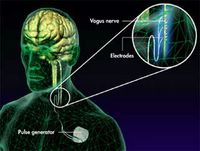 Scientists have developed a "brain pacemaker" that can cure depression by drilling holes into the skull and attaching electrodes to the brain which create a brighter mood.
Four women and two men had two electrodes planted into their brain to stimulate one of the areas involved in mood control. The other ends of the wires were threaded under the scalp down to the lower neck area. Next, the patients had a pulse generator implant, the "pacemaker", sewn in under the skin of their chest. The wires were hooked up to this to provide constant brain stimulation.
All six volunteers reported acute effects once the current was switched on. These included a sudden brightening of the room and a "disappearing of the void".
However, two of the six, lapsed back into depression within six months. But the scientists believe that fine-tuning the implant treatment could eventually cure most cases of severe depression. [Popular Science]
Scientists have developed a "brain pacemaker" that can cure depression by drilling holes into the skull and attaching electrodes to the brain which create a brighter mood.
Four women and two men had two electrodes planted into their brain to stimulate one of the areas involved in mood control. The other ends of the wires were threaded under the scalp down to the lower neck area. Next, the patients had a pulse generator implant, the "pacemaker", sewn in under the skin of their chest. The wires were hooked up to this to provide constant brain stimulation.
All six volunteers reported acute effects once the current was switched on. These included a sudden brightening of the room and a "disappearing of the void".
However, two of the six, lapsed back into depression within six months. But the scientists believe that fine-tuning the implant treatment could eventually cure most cases of severe depression. [Popular Science]
HUBO, Introduction of Human Type Robot
 A team led by professor Oh Jun-ho of the Mechanical Engineering department at KAIST held its first public demonstration of a walking human type robot called HUBO in the school’s Taewoolguan yesterday after three years of research. HUBO is shown bending 10 fingers with primary school children. During the show, HUBO danced and played games with spectators. HUBO measures 125cm and weighs 55kg, and can walk 30cm at a time (left and right strides: 15cm), and can turn itself at an angle of 45 degrees. It has 41 joints and motors all over its body allowing it various body movements. [Engadget]
Robotic Mannequin Spies on Consumers
 A Japanese firm has developed a mannequin robot that can follow your movement, strike a pose for you and spy on you and what you are buying.
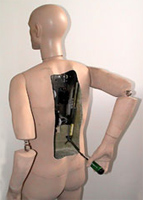 The female robot codenamed Palette uses motion-capture technology to recreate the movements of supermodels. It caan also judge the age and sex of shoppers and even identify the bags they are carrying and pass the info along for marketing. She will be available in two versions, the whole body without legs or just the upper torso for jewelry displays. If well recepted, expect to see her with legs along with male and child models. Oh, and did I mention she has no face? The designer says this would distract from the items being modeled.
Can you Bowl with the Xbox 360...
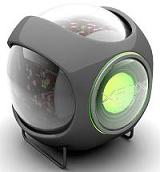 If this turns out to be the design of the next Xbox, furniture makers are going to have to re-think their designs. If Microsoft wants to "own our living rooms", this is not the way. I mean come on, will this fit in with anybody's current home entertainment system? Maybe they will make some new round receivers and Tivos to match... geesh
iPod Camera Connector
 Last week's news about the iPod's upcoming camera connector looks to be real. However, it wouldn't take much for some of you hackers to make a cable with a iPod dock connector on one end and a usb port on the other would it? Could this open the door to tons of iPod hacks? If the iPod really does have USB-On-The-Go locked inside I'd say YES!
February 27, 2005
Dell dives into HDTV Market
Business strategy types often speak of "first mover advantage." The basic premise is pretty simple: The guy that gets there first has a better chance of winning. When it comes to new product categories, Dell is rarely, if ever, a first mover, and there's a simple reason: It doesn't have to be. What Dell is usually first at doing is bringing its formidable volume production and aggressive pricing model to bear on a market, giving most of its competitors fits.
HDTV is no exception for Dell. It has had several smallish LCD-based HDTVs on the market, but took its time bringing out larger displays, but now the wait is over. The company has two 42-inch plasma-based displays that it's selling direct from its Web site, true to Dell form. Both are competitively priced while maintaining a good level of quality.
The W4200 and the W4200HD are priced at $2,300 and $3,400, respectively. Both use PixelWorks' DNX video processors, and both employ Samsung panels. The difference is that the W4200 has EDTV resolution (852x480), while the W4200HD has a native resolution of 1024x768 with non-square pixels. We recently took the W4200HD for a test-drive and like the way it handled. If you're in the market for a flat-screen HDTV, should the W4200HD be on your short list?
The W4200HD has a native pixel resolution of 1024x768, so it isn't a true HD device, because it doesn't have enough pixels to draw a 1280x720 (720p) HDTV image. This is common among 42-inch PDPs, and to the W4200HD's credit, its PixelWorks video processor does a very good job scaling both 720p and 1080i HDTV images to fit its panel.
The W4200HD has two tuners built in, one of which is an ATSC over-the-the air HD tuner. Having a built-in ATSC tuner allows this set to display HDTV channels broadcast in your area, though you will need an antenna (not included). In addition to its generally solid performance, having the ATSC tuner built in is a big plus: A standalone ATSC tuner will set you back another $200 to $300.
So in the race to be a player in the 42-inch plasma panel HDTV market, Dell didn't get there first. But in taking its time, Dell has put together a good panel (from Samsung) with a good video processor (from PixelWorks), and combined that with two tuners (one of them ATSC) to produce a compelling plasma offering at $3,499. But there are a lot of 42-inch 1024x768 plasma panels on the market for under $3,000 now, and while we like the Dell, we're not sure that it will be able to command a $500-700 price premium versus other panels. The ATSC tuner is certainly a plus for the W4200HD, but a standalone ATSC tuner can be found for $300, so if a panel costs $2,700, you could get it and a standalone tuner, and still come out ahead.
For its performance and feature set, we do like the W4200HD, and it would make a solid addition to almost anyone's home entertainment center. But a less-expensive alternative might be the better way to go if you're trying to keep your HDTV acquisition cost below a set price ceiling. If you're okay with parting with more dollars to get a quality panel, the Dell will fit the bill. Just prepare yourself for a bigger bill to get that good fit.
Dell Computers Still not working with AMD
Dell has decided to continue their relationship with Intel and omit AMD from their computers. While I do see that AMD had gained some market "faith", I do believe that the majority of non-techie computer users still find Intel to be the chip they want inside their computer. What do you think?
February 24, 2005
IBM throws weight behind multi-OS push | CNET News.com
IBM has quietly added a new option to the suddenly vogue market for "hypervisor" software that lets a computer run multiple operating systems simultaneously, CNET News.com has learned.
But Big Blue's efforts aren't likely to squash a potential rival just flexing its muscles.
IBM has released source code for its Research Hypervisor, or rHype, on its Web site, letting anyone examine the approach of a company renowned for its expertise in the field. One distinguishing feature: rHype works with multiple processor varieties, including IBM's Power family, widely used x86 chips such as Intel's Xeon, and the new Cell microprocessor codeveloped by IBM, Sony and Toshiba.
Full Story at CNET News.com

Subscribe to:
Posts (Atom)