February 24, 2005
IBM throws weight behind multi-OS push | CNET News.com
IBM has quietly added a new option to the suddenly vogue market for "hypervisor" software that lets a computer run multiple operating systems simultaneously, CNET News.com has learned.
But Big Blue's efforts aren't likely to squash a potential rival just flexing its muscles.
IBM has released source code for its Research Hypervisor, or rHype, on its Web site, letting anyone examine the approach of a company renowned for its expertise in the field. One distinguishing feature: rHype works with multiple processor varieties, including IBM's Power family, widely used x86 chips such as Intel's Xeon, and the new Cell microprocessor codeveloped by IBM, Sony and Toshiba.
Full Story at CNET News.com


Nintendo Revolution???
 Is this a leaked picture of the Nintendo Revolution? That's the story this morning... circular huh? They look like mock-ups to me. The question is are they Nintendo's mock-ups or some bored photoshoppers mock-up.
February 23, 2005
Big Xbox Replacement Cord
 The Xbox replacement cord is a bit bigger than the original. Now it's packing its own surge protector stamped with a warning: This Xbox Protection Cord disconnects power to the Xbox console if it detects an electrical problem. [Joystiq]
February 22, 2005
Star Wars Episode 3 Screenshots - Has Been Removed
 "The entire story of Star Wars: Episode 3, laid out in about 80 screenshots from the film. Hurry and check it out before LucasArts sues the poor guy. Warning, the page contains about 6 MB of images." - Update - This site has been removed for some reason, possibly traffic?
Landspeeder built out of modded Harley on eBay
 Gary is selling his custom-built Land Speeder replica on eBay:
This Landspeeder is built on top of a three-wheel Harley Davidson golf kart and seats two; there's room for you and your droid, Wookie or Jedi Master. This Landspeeder is perfect for driving around the local golf course or your lot. You could also take it to Burning Man 2005! It's loaded with features!
* Built in talking car alarm with remote (says "System armed"; "System dis-armed" and "I've been tampered with!")
* Built in PA system for yelling out things like "This is not the vehicle you're looking for, officer!"
* Built in 70 watt audio amplifier and forward-facing 6 X 9 speakers for hooking up your MP3 player to blast out John Williams' excellent "Star Wars" theme!!
* 350 watt - 110 volt AC Inverter! Perfect for plugging in a laptop in so you can surf the web, on the golf course!
* Headlights, LED rear lights and incadescent side marker lights!
* Animated engines pods containing hundreds of LED and incadescent lights!
* Rope lighting!
* Comes with handy "drink and drive" ice chest which fits behind the seat!
* Powered by a 2 cycle Harley Davidson engine! Has forward and reverse!
* Comes with gas can and 2 cycle oil
* Comes with Two (count 'em) TWO animated light sabers!
* Comes with spare tire and extra Drive Belt
* includes loads of bumper stickers which say things like "Ewoks - it's what's for dinner" and "My kid light-sabered your honor student at Jedi Academy"
[Link]
Gary is selling his custom-built Land Speeder replica on eBay:
This Landspeeder is built on top of a three-wheel Harley Davidson golf kart and seats two; there's room for you and your droid, Wookie or Jedi Master. This Landspeeder is perfect for driving around the local golf course or your lot. You could also take it to Burning Man 2005! It's loaded with features!
* Built in talking car alarm with remote (says "System armed"; "System dis-armed" and "I've been tampered with!")
* Built in PA system for yelling out things like "This is not the vehicle you're looking for, officer!"
* Built in 70 watt audio amplifier and forward-facing 6 X 9 speakers for hooking up your MP3 player to blast out John Williams' excellent "Star Wars" theme!!
* 350 watt - 110 volt AC Inverter! Perfect for plugging in a laptop in so you can surf the web, on the golf course!
* Headlights, LED rear lights and incadescent side marker lights!
* Animated engines pods containing hundreds of LED and incadescent lights!
* Rope lighting!
* Comes with handy "drink and drive" ice chest which fits behind the seat!
* Powered by a 2 cycle Harley Davidson engine! Has forward and reverse!
* Comes with gas can and 2 cycle oil
* Comes with Two (count 'em) TWO animated light sabers!
* Comes with spare tire and extra Drive Belt
* includes loads of bumper stickers which say things like "Ewoks - it's what's for dinner" and "My kid light-sabered your honor student at Jedi Academy"
[Link]
Brainbar fix me a (What am I thinking)?
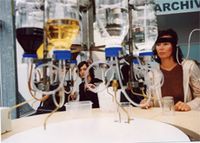 Brainbar is a mechanical bar that mixes drinks adapted to the visitor's brainwaves. The customer wears a sensor-studded headband and the robot bartender reads the brain frequencies(electroencephalogram) in the alpha and beta wavelength. These wavelengths are generally considered to indicate the states of relaxation and activity in the mind.
Depending on how the bar is tuned it will then mix a drink to enhance or suppress the guest's feelings. BrainBar is a kind of manipulator that gives a party its perfect state of enhanced socialising, adjusting the drinks so that every guest stays within acceptable parameters for a "good" behaviour or, if the settings allow, a "bad" one.
The project explores how much a person is prepared to submit to external forces and how far s/he can allow a machine to intrude on the body.
Brainbar is a mechanical bar that mixes drinks adapted to the visitor's brainwaves. The customer wears a sensor-studded headband and the robot bartender reads the brain frequencies(electroencephalogram) in the alpha and beta wavelength. These wavelengths are generally considered to indicate the states of relaxation and activity in the mind.
Depending on how the bar is tuned it will then mix a drink to enhance or suppress the guest's feelings. BrainBar is a kind of manipulator that gives a party its perfect state of enhanced socialising, adjusting the drinks so that every guest stays within acceptable parameters for a "good" behaviour or, if the settings allow, a "bad" one.
The project explores how much a person is prepared to submit to external forces and how far s/he can allow a machine to intrude on the body.
Xbox 360 News
 Engadget is reporting that the Xbox 360 is definitely going to come with wireless controllers; and that it's going to have an optional hard drive that attatches to the top of the Xbox 360 "in a really slick way, almost like the hood scoop on a muscle car." So you will be able to add the hard drive later insinuating there will be at least two versions of the Xbox 360.
Talk to Your TV
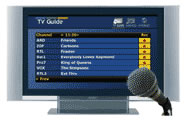 Opera Software ASA today announced their voice-enabled Electronic Program Guide (EPG) for home media, introducing home entertainment users across the globe to the future of human-computer interaction.
The voice-enabled EPG is a significant breakthrough in the effort to enhance the customer experience. Finally, there is an easier way for people to interact with their DVD players, DVRs and digital TV set top boxes without having to negotiate an array of remote controls.
A differentiating benefit for consumers, the voice-enabled EPG helps make navigating complex data structures easy by using simple voice commands. For example, with the increasingly daunting number of television channels available, sorting through information and channel navigation can be done without effort by talking to your set top box.
[eHomeUpgrade]
Opera Software ASA today announced their voice-enabled Electronic Program Guide (EPG) for home media, introducing home entertainment users across the globe to the future of human-computer interaction.
The voice-enabled EPG is a significant breakthrough in the effort to enhance the customer experience. Finally, there is an easier way for people to interact with their DVD players, DVRs and digital TV set top boxes without having to negotiate an array of remote controls.
A differentiating benefit for consumers, the voice-enabled EPG helps make navigating complex data structures easy by using simple voice commands. For example, with the increasingly daunting number of television channels available, sorting through information and channel navigation can be done without effort by talking to your set top box.
[eHomeUpgrade]
iPod Upgrades on Wednesday?
 MacShrine is reporting that Wednesday might be the day for the rumored iPod upgrades. iPod mini getting a color screen and a bump to 5 or maybe 6GB and that there may be a bluetooth iPod on the horizon. There also could be an introduction of a 60GB iPod for $449.
[Engadget]
MacShrine is reporting that Wednesday might be the day for the rumored iPod upgrades. iPod mini getting a color screen and a bump to 5 or maybe 6GB and that there may be a bluetooth iPod on the horizon. There also could be an introduction of a 60GB iPod for $449.
[Engadget]
February 21, 2005
Moon measurements might explain away dark energy
Plans to trace the Moon's orbit with extraordinary new accuracy could reveal kinks in Einstein's theory of gravity and help explain the mysterious accelerating expansion of the universe, says a US researcher.
The acceleration cannot be explained by known forces in the Universe. To account for the behaviour, cosmologists have introduced the concept of a new, as yet unseen, force - dark energy.
But Gia Dvali, of New York University, US, believes there could be another explanation. He thinks the accelerating expansion might be caused by unexpected properties of gravity, which are only seen over very large distances. Taking inspiration from string theory, which proposes the existence of several extra dimensions, Dvali, and NYU colleagues Gregory Gabadadze and Massimo Porrati, suggests that gravity may leak into an extra dimension on this large scale.
"The accelerated universe can be a window of opportunity for understanding the most fundamental aspects of gravitation, and may signal the modification of standard laws of gravity at very large distances," Dvali told an audience at the American Association for the Advancement of Science meeting in Washington, DC, US.
Millimetre accuracy
The scheme to measure the Moon's orbit involves firing a laser beam at mirrors left on the surface by the Apollo 11 astronauts and measuring the time it takes for photons to return. This makes it possible to trace the lunar orbit and, so far, astronomers have used the technique to track it with an accuracy of a few centimetres.
Now, Tom Murphy, Chris Stubbs and Eric Adelberger at the University of Washington in Seattle, US, plan to use more precise laser equipment to measure the Moon's path to just a few millimetres. At this scale, Dvali's theory predicts that subtle deviations in the Moon's orbit ought to show up.
"If you mess around with gravity, orbits are one of the first things to go," agrees Licia Verde, a theoretical physicist at the University of Pennsylvania, US. The new experiments have yet to get funding but could take place within the next couple of years.
"One way or another it would be a fantastic result," adds Sean Carroll, at the University of Chicago, US. But he also warns that there could be other explanations for any deviations in the Moon's path.
[New Scientist]
Human Skin as a Network Conduit?
NTT's Red Tacton has created a "human area network" that uses electrical signals present on the surface of the body to create a network with the human body. Imagine an mp3 player sending audio to your ears by using your skin as the network. Imagine transmitting security systems that can ID and track you based on conductive surfaces. This is getting kinda scary...
[Red Tacton]
February 18, 2005
Robots Learn to Walk Like Humans
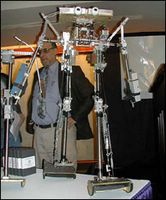 Robots that walk like humans - that familiar staple of science fiction films - have been developed for real by scientists in the US and Holland.
Robot (BBC)
The batteries are in the arms
Three bipedal designs, each built by a different research group, use the same principle to achieve their human-like gait. One even adapts its stride to changing terrain.
Long considered a holy grail of robotics, getting machines to walk like people has proven notoriously difficult to achieve. Details were announced on Thursday at the American Association for the Advancement of Science annual meeting in Washington DC.
Though machines like those in the film I Robot are still a long way off, robots using this method of walking could have uses in dangerous space missions or in cleaning up nuclear and toxic waste. The work could transform the way humanoid robots are built and brings the prospect of robotic replacement limbs a step closer. In other humanoid walking robots, such as Honda's Asimo, motors control much of the movement. The new machines have less control over their movement and use up less energy than "mainstream" robots, yet they walk in a more human-like manner.
Buckethead
Two of the machines, developed at Cornell University in the US and Delft University in Holland respectively, are built in a very similar way. But while the Cornell robot is powered by batteries in its arms, the Delft robot uses gas canisters in an attempt to mimic human muscles. It has an empty bucket for a head, to emphasise that it uses no intelligence. The third robot, developed at the Massachusetts Institute of Technology (MIT), has been nicknamed the Toddler on account of its walking style. It uses neural networks to learn - adapting its movement according to the terrain it is on. It is about 43cm tall, weighs 2.8kg and has curved feet that look like clogs.
"For the first time, we've demonstrated a robot that learns how to walk without anything in its control system that tells it how to," said Russ Tendrake of the cognitive and brain sciences department at MIT. "It learns how to walk in about 20 minutes from a blank slate and adjusts itself with every step."
The Toddler transfers its weight from one foot to the other until it gains enough energy to start walking forward. It can start, stop, steer and walk backwards. The research could have much to tell us about the way humans walk: it suggests passive dynamic movement plays a key role in human locomotion.
[BBC News]
Robots that walk like humans - that familiar staple of science fiction films - have been developed for real by scientists in the US and Holland.
Robot (BBC)
The batteries are in the arms
Three bipedal designs, each built by a different research group, use the same principle to achieve their human-like gait. One even adapts its stride to changing terrain.
Long considered a holy grail of robotics, getting machines to walk like people has proven notoriously difficult to achieve. Details were announced on Thursday at the American Association for the Advancement of Science annual meeting in Washington DC.
Though machines like those in the film I Robot are still a long way off, robots using this method of walking could have uses in dangerous space missions or in cleaning up nuclear and toxic waste. The work could transform the way humanoid robots are built and brings the prospect of robotic replacement limbs a step closer. In other humanoid walking robots, such as Honda's Asimo, motors control much of the movement. The new machines have less control over their movement and use up less energy than "mainstream" robots, yet they walk in a more human-like manner.
Buckethead
Two of the machines, developed at Cornell University in the US and Delft University in Holland respectively, are built in a very similar way. But while the Cornell robot is powered by batteries in its arms, the Delft robot uses gas canisters in an attempt to mimic human muscles. It has an empty bucket for a head, to emphasise that it uses no intelligence. The third robot, developed at the Massachusetts Institute of Technology (MIT), has been nicknamed the Toddler on account of its walking style. It uses neural networks to learn - adapting its movement according to the terrain it is on. It is about 43cm tall, weighs 2.8kg and has curved feet that look like clogs.
"For the first time, we've demonstrated a robot that learns how to walk without anything in its control system that tells it how to," said Russ Tendrake of the cognitive and brain sciences department at MIT. "It learns how to walk in about 20 minutes from a blank slate and adjusts itself with every step."
The Toddler transfers its weight from one foot to the other until it gains enough energy to start walking forward. It can start, stop, steer and walk backwards. The research could have much to tell us about the way humans walk: it suggests passive dynamic movement plays a key role in human locomotion.
[BBC News]
February 17, 2005
Dell Announces 24″ Widescreen UltraSharp 2405FPW
 I want this monitor... The 2405FPW starts shipping March 1st in the Americas and Europe, and like most 23-24? displays it boasts a 1920x1200 resolution – matching the Samsung 243T. Beating the pants off the Samsung (and others), the Dell 2405FPW actually has a 12ms gray-to-gray and 16ms black-to-white response, plus 1000:1 contrast ratio and 500nits brightness, meaning gaming and video should be simply outstanding. And, at a MSRP of $1199US, it breaks all price barriers for an equivalent display.
How else does it one-up the competition? Let’s see. How about four USB 2.0 ports and a 9-in-1 memory card reader on the side of the panel. Clears up the clutter on your desk! Some models like the Apple 23? Cinema Display also offer USB2.0 ports, but many like the HP and Samsung offer none. In addition to DVI and VGA inputs, you also get S-Video, composite and component (hi-def) inputs. Hmmm... so you can use this as a gaming display, DVD player, hi-def TV and more! And it has both PIP and Splitscreen so you can take advantage of the size to watch two things at once.
[Dell]
I want this monitor... The 2405FPW starts shipping March 1st in the Americas and Europe, and like most 23-24? displays it boasts a 1920x1200 resolution – matching the Samsung 243T. Beating the pants off the Samsung (and others), the Dell 2405FPW actually has a 12ms gray-to-gray and 16ms black-to-white response, plus 1000:1 contrast ratio and 500nits brightness, meaning gaming and video should be simply outstanding. And, at a MSRP of $1199US, it breaks all price barriers for an equivalent display.
How else does it one-up the competition? Let’s see. How about four USB 2.0 ports and a 9-in-1 memory card reader on the side of the panel. Clears up the clutter on your desk! Some models like the Apple 23? Cinema Display also offer USB2.0 ports, but many like the HP and Samsung offer none. In addition to DVI and VGA inputs, you also get S-Video, composite and component (hi-def) inputs. Hmmm... so you can use this as a gaming display, DVD player, hi-def TV and more! And it has both PIP and Splitscreen so you can take advantage of the size to watch two things at once.
[Dell]
Inflatable Hotel Rooms in Space
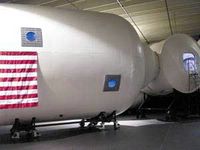 Popular Science (via Caveat lector) has a cover story about Robert Bigelow project to build a 330-cubic-meter orbiting space hotel. Bargain-basement room rate: $1 million a night.Announced last year, the full-scale mock-ups of the Nautilus space-station module features two 22-foot-diameter inflatable modules.
Developed at NASA as part of a project called TransHab, inflatable space-station modules weigh less, and they launch in a compressed state which allows them to use less-powerful launch vehicles and makes for roomier space stations. After a rocket fires a Nautilus into space, explosive bolts will release the girdle securing the compressed hull, and then the station’s life support system, housed in the core, will inflate the structure with breathable air. Power comes from solar panels.
Bigelow Aerospace is also floating a $50-million prize to entice other companies to create a safe, reliable orbital space vehicle to transport guests to the front door—or rather, the airlock.
If all goes well with orbital tests of one-third-scale modules to be launched at the end of the year, the first habitable Nautilus could be launched in 2008.
Popular Science (via Caveat lector) has a cover story about Robert Bigelow project to build a 330-cubic-meter orbiting space hotel. Bargain-basement room rate: $1 million a night.Announced last year, the full-scale mock-ups of the Nautilus space-station module features two 22-foot-diameter inflatable modules.
Developed at NASA as part of a project called TransHab, inflatable space-station modules weigh less, and they launch in a compressed state which allows them to use less-powerful launch vehicles and makes for roomier space stations. After a rocket fires a Nautilus into space, explosive bolts will release the girdle securing the compressed hull, and then the station’s life support system, housed in the core, will inflate the structure with breathable air. Power comes from solar panels.
Bigelow Aerospace is also floating a $50-million prize to entice other companies to create a safe, reliable orbital space vehicle to transport guests to the front door—or rather, the airlock.
If all goes well with orbital tests of one-third-scale modules to be launched at the end of the year, the first habitable Nautilus could be launched in 2008.
Subscribe to:
Posts (Atom)